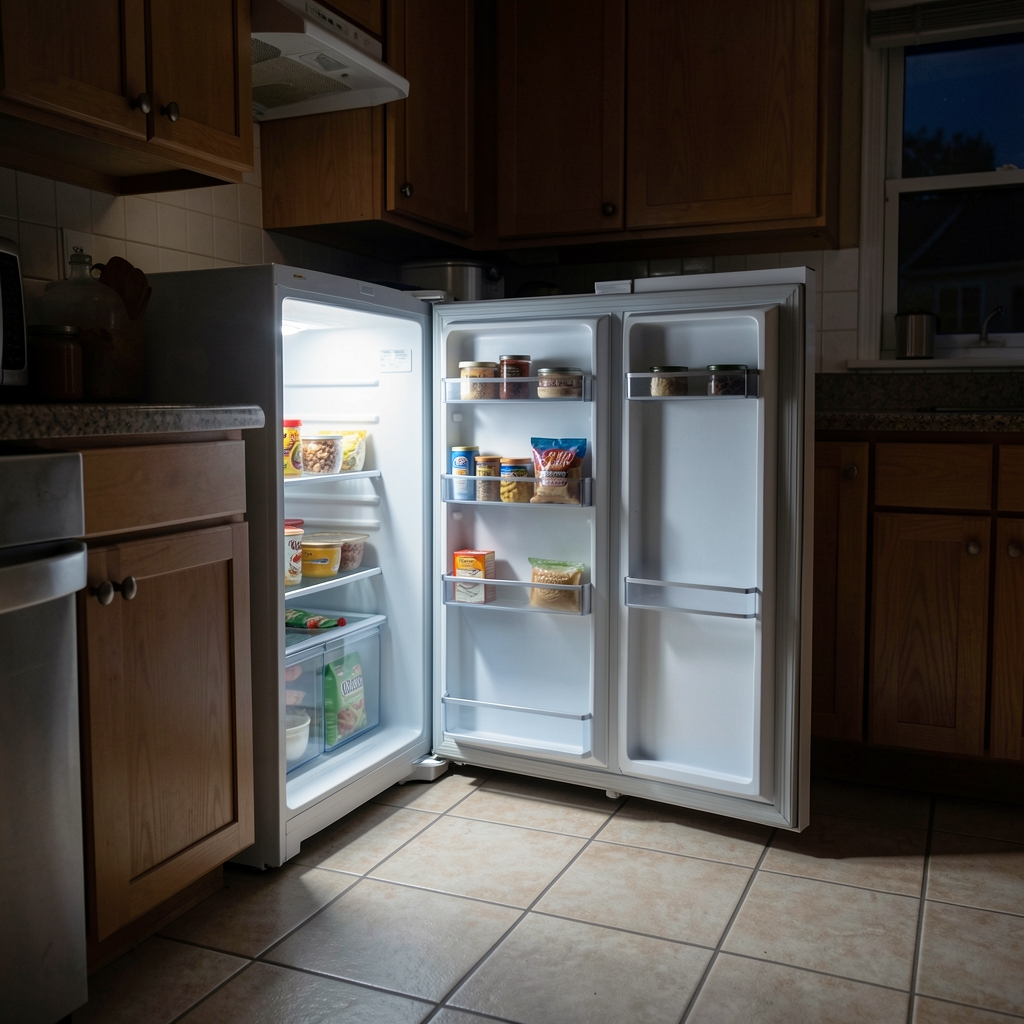
Night-time Eating
The Quiet Pull of the Kitchen at Night.
Eleanor Whitfield
·

Eating is one of the most consistently under-attended activities in a person's day. A meal that might take twenty minutes if eaten with full attention is more often consumed in half the time, with a phone on the table or a screen in the peripheral field, the mind somewhere other than the plate. This is not a modern failing, but the modern environment has made it considerably easier to achieve.
Distracted eating operates on a simple principle: when attention is divided, the eating experience is diminished. This is not merely aesthetic — not only a matter of enjoying food less. Diminished attention during eating has measurable effects on how much is consumed, how well fullness is registered, and how satisfying the meal ultimately feels. A person who eats the same food in two conditions — once with full attention and once while engaged with a screen — will typically consume more in the distracted condition and feel less satisfied afterward.
The mechanism is straightforward. Fullness is not an instantaneous signal. It builds across the course of a meal, arriving clearly around fifteen to twenty minutes after eating begins. If eating pace is rapid and attention is elsewhere, this signal arrives late relative to the volume consumed. The meal has ended before the signal had time to reach the level of awareness.
There is also a dimension of memory involved. Experiments in eating behaviour have found that people who eat a meal while distracted tend to eat more at a subsequent snacking opportunity than people who ate the same meal with attention. The mechanism appears to involve the encoding of the meal in memory: an attentive meal is remembered as a meal, and the memory itself contributes to the sense of having eaten. A distracted meal is less fully encoded, leaving the appetite system somewhat less satisfied than the actual intake would predict.
This is one of the stranger findings in the field of eating awareness: the act of noticing what you ate helps the body register that you ate it. Attention is not merely a pleasant accompaniment to eating — it is a functional part of the eating experience.
"A meal eaten with attention is remembered as a meal. A meal eaten while elsewhere is merely something that happened."
Eating pace is, in practice, the most immediately adjustable variable in the eating experience. It does not require changing what you eat, when you eat, or how much you intend to eat. It requires only that the pace at which food moves from plate to mouth is slowed to a rate that allows the body's own feedback system to operate in real time rather than retrospectively.
For most people accustomed to eating quickly, a deliberate slowing feels artificial at first. The habit of rapid eating is deeply embedded — it formed over years of rushed lunches, early starts, and a general cultural tendency to regard eating as a task to be completed rather than an activity to be engaged with. Reversing it takes repetition rather than resolution.
Practical techniques for slowing the eating pace do not need to be elaborate. Placing cutlery down between each bite creates a natural pause. Chewing more completely before swallowing — not to an extreme degree, but sufficiently to actually process the food — adds time and adds awareness. Taking a breath between bites. Noticing the flavour of the food rather than simply its texture. These are small, repeatable adjustments that compound over the course of a meal into a significantly different relationship with the pace of eating.
The change in the experience of the meal is often noted with some surprise by people who try this deliberately for the first time. Food that has been eaten quickly for years suddenly has a flavour profile that was not previously apparent. The meal feels longer without feeling tedious. And the fullness signal, given sufficient time to arrive, is noticed before the plate is empty rather than after — which is, for many people, a genuinely novel experience.
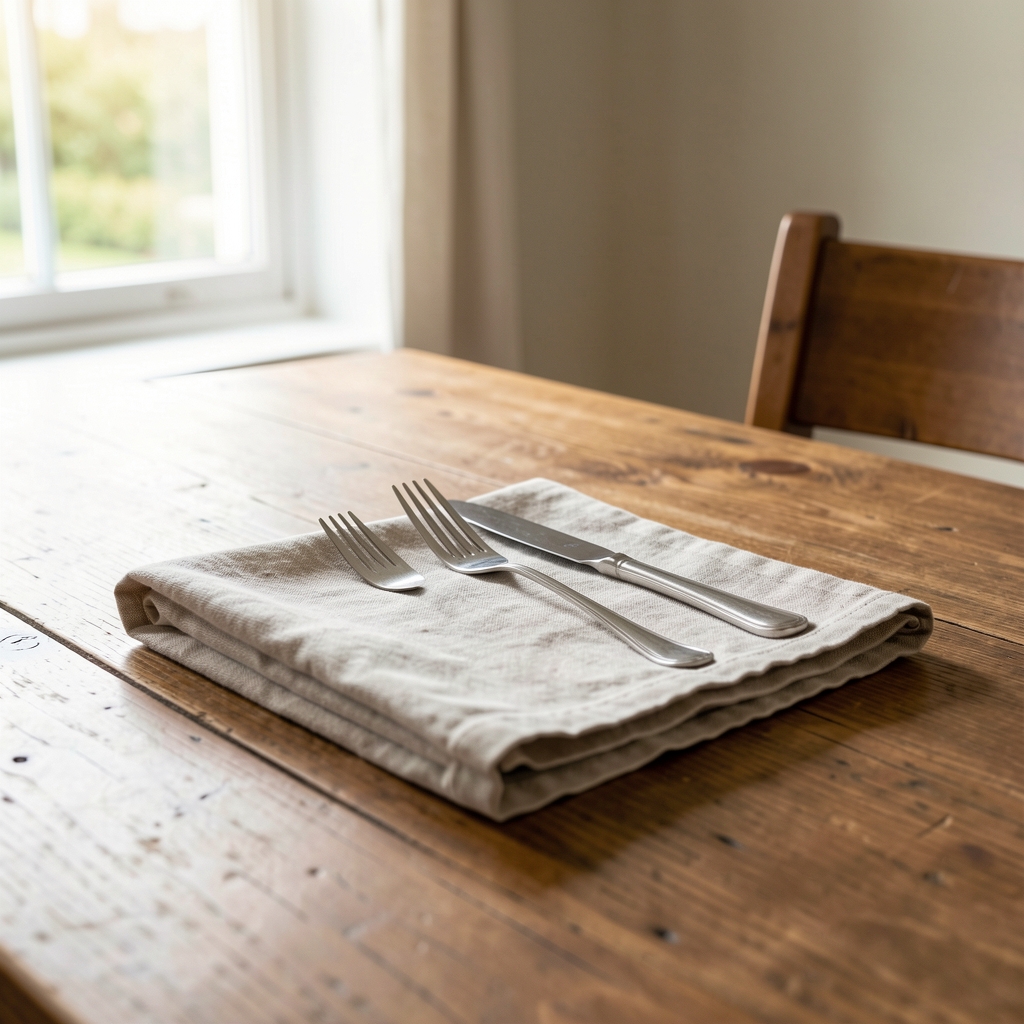
The undistracted table — London, 2026
Mindful portion awareness is sometimes confused with portion control — with measuring, tracking, or restricting. The two are related but distinct. Portion control is an external system imposed on the eating process. Mindful portion awareness is an internal one: the capacity to notice, as the meal proceeds, what the body is communicating about its state, and to use that information to guide the decision about when to stop.
This capacity is native to the body. Infants regulate their intake with considerable precision, stopping when full and resuming when hungry, without any instruction or external framework. Adults retain this capacity, but in many cases it has been overlaid by years of eating for reasons other than hunger, by social norms that attach significance to finishing a plate, by fast eating that bypasses the feedback loop, and by the general busyness of a life in which eating has been accorded low priority as an experience.
Recovering this capacity requires, above all, conditions in which the body's signals can be noticed. Those conditions include slowing the eating pace, reducing competing stimuli, and bringing some degree of conscious attention to how the eating experience is changing across the course of a meal. It also helps to begin a meal with a brief, genuine check-in: a few seconds of noticing the actual state of hunger before beginning to eat, rather than eating on schedule or on reflex.
The check-in before eating and the pause mid-meal are perhaps the two most useful practices in this area. Together, they bookend the meal with moments of awareness that allow the body's own appetite system to function as designed. Neither requires a timer, a journal, or a calculation. They require only attention — which is, it turns out, the one ingredient that most modern eating consistently lacks.
The question of eating environment is worth returning to in the context of distracted eating. The environment does not merely affect how much is eaten — it shapes the entire character of the eating experience. An environment designed for eating — a table, a chair, no competing devices — invites a different quality of attention than a sofa, a screen, and food balanced on a knee.
This is not about formality. It is about the signal that the environment sends to the body and mind about what kind of activity is happening. A dedicated eating space communicates that eating is the activity — that this is what is being done now, and other things are suspended. A casual or multi-purpose eating arrangement communicates the opposite: that eating is happening alongside other things, in the background of a more important activity.
For people with established habits of screen-accompanied eating, the suggestion to separate eating from screens often meets with resistance. The screen, for many people, has become part of how eating feels comfortable — the combination is familiar, and the absence of the screen can feel like a kind of deprivation. This is worth noting as information: the level of discomfort when eating without distraction is itself a signal about how habitual the distracted eating has become.
Starting with a single daily meal that is eaten without a screen — breakfast is often the most accessible, because the day has not yet accumulated its urgencies — provides a low-resistance entry point. The practice does not have to be carried across every meal immediately. One attentive meal per day, over time, tends to shift the general relationship with eating more than a single week of complete screen-free dining attempted in a burst of resolution.
Food journalling, used in conjunction with practices of attentive eating, functions as a kind of external memory for a process that is otherwise entirely internal. The journal does not need to be detailed or technical. A simple note — what was eaten, at what time, in what circumstances, and what the emotional texture of the moment was — provides sufficient data, over the course of a week or two, to reveal patterns that are genuinely informative.
The food and mood connection becomes visible through this kind of record in ways that introspection alone does not deliver. Most people have a general sense that they eat differently when stressed or tired or bored, but the specifics — when exactly, how much, what kind of food, what preceded it — remain vague. The journal makes the vague specific, and specific information is the foundation of considered change.
The tone of the journal matters. A food journal written as a record of failures will not be used for long. A food journal written as genuinely curious observation — neither self-congratulatory nor self-critical, just honest — tends to be both more accurate and more sustainable. The aim is not to assess. It is to see. And seeing, as with most things in the territory of everyday wellbeing, tends to be the thing that changes the situation, simply by virtue of having happened.

Tobias Marsden is a contributing writer at Tarino Gazette. He writes on eating behaviour, attention, and the everyday practices that shape how people experience food and routine.
More from this publication